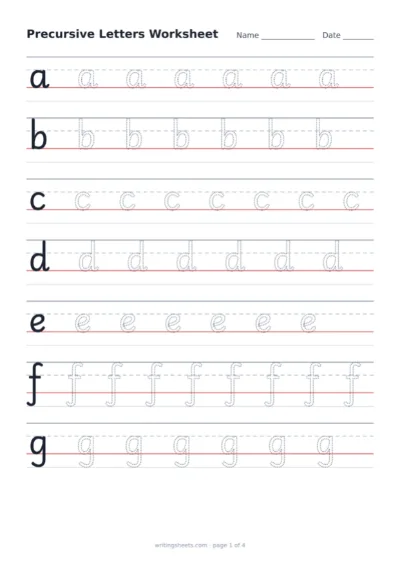
What Makes a Letter Precursive
- An exit flick: letters that end on the baseline, such as a, d, h, i, l, m, n, t and u, finish with a small curve out to the right, ready to join on to the next letter.
- A lead-in, in some schemes: a stroke up from the baseline to where the letter starts. Not every school uses lead-ins, and the UK print style on these sheets doesn't, but the exit flicks are the same.
- The letters stay separate. Children write each letter on its own; the joins come later.
Practise by Letter Family
Children learn letters fastest in groups that start with the same movement. The families most UK schools use:
| Family | Letters | The movement |
|---|---|---|
| Long ladder | l, i, t, u, j, y | Straight down, then flick |
| One-armed robot | r, b, n, h, m, k, p | Down, back up and over |
| Curly caterpillar | c, a, d, o, s, g, q, e, f | Start with the curve of a c |
| Zigzag monster | z, v, w, x | Straight diagonal lines |
To make a sheet of one family, choose "A name, words or sentences" and type its letters, a few to a line.
When to Start Joining
Once a child forms every letter correctly in precursive, joining is mostly a matter of not lifting the pencil. See joined handwriting for the four joins and a sheet for each. For capital letters and correct starting points, see letter formation.