Sheets for Ages 3 and 4
| Sheet | What it is | Start when |
|---|---|---|
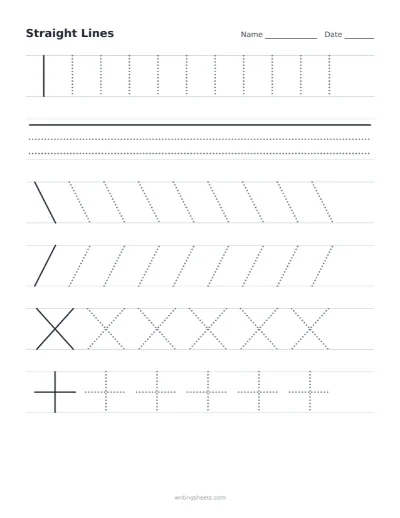
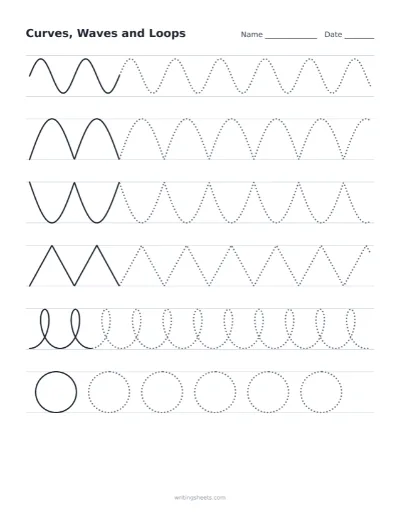
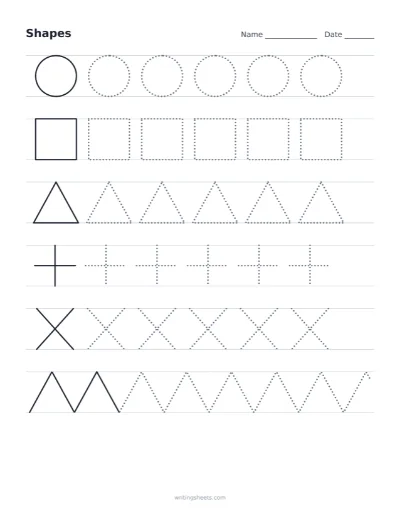
| Pre-writing patterns | Lines, curves, zigzags, loops and shapes | A child can hold a crayon and make marks |
| Name tracing | Their own name, solid then dotted | They recognise their name |
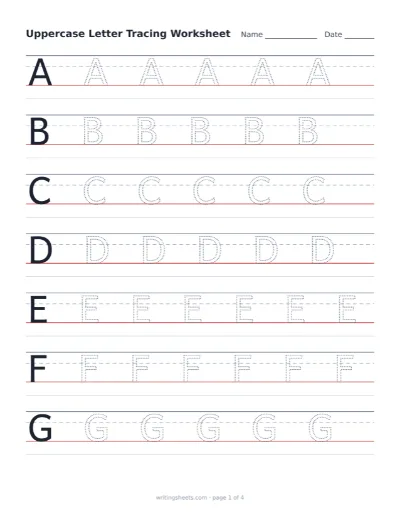
| Letter tracing | Capitals and small letters, one at a time | They can draw a line down and a circle |
| Number tracing | 0 to 9 | They count to five or more |
| Pre-primer sight words | The first sight words: a, and, the, I, see | They know most letter sounds |
| Mark making (UK) | EYFS patterns on A4 | Nursery |
What 3 and 4 Year Olds Can Usually Do
- Around 3: copy a line down, a line across and a circle; hold a crayon in the fist or with the fingers pointing down.
- Around 4: copy a cross (+) and a square; start to hold a pencil between thumb and fingers; write some letters, often from their own name.
- By 5: copy a triangle and a diagonal cross (×), which means most letters are within reach.
Children vary a lot at this age. If a sheet causes tears, it is too soon: go back to big marks with chalk or paint and try again in a few weeks.
Tips for This Age
- Large size, few rows. "Large" in the maker has letters about 22 mm tall, and two or three rows is plenty for one sitting.
- Short crayons or broken crayons encourage a pinch grip. See pencil grip.
- Finger first: trace the solid example with a finger, then the dotted rows with a crayon.
- Capital first letter, then small letters in their name, the way school will teach it.
The next step is kindergarten and reception.