The Order to Learn Cursive Letters
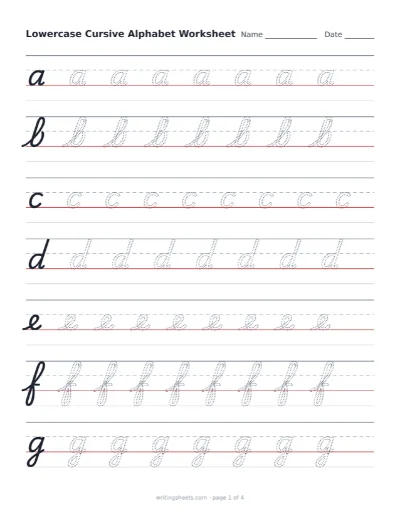
Schools rarely teach cursive from a to z. They group the small letters by their first stroke, because once a child can make that stroke, every letter in the group comes quickly.
- Undercurve letters: b, e, f, h, i, j, k, l, p, r, s, t, u, w. Each starts on the baseline and swings up, like the first stroke of an i.
- Downcurve letters: a, c, d, g, o, q. Each starts with the curve of a c, so learn the c first.
- Overcurve letters: m, n, v, x, y, z. Each starts with a hump, like the start of an n.
Capitals usually come after the small letters, because the small ones make up most of what a child writes.
Letters That Join at the Midline
Most cursive letters end at the baseline and the next letter starts from there. Four end high instead, with a small checkstroke: b, o, v, w. The letter after one of these starts at the midline, so "on" and "an" join differently. These joins are where most children's cursive goes wrong.
Tall Letters and Letters With Tails
Tall letters, reaching the top line: b, d, h, k, l, t. Letters with tails, going below the baseline: f, g, j, p, q, y, z. The f does both. Everything else sits between the baseline and the dashed midline.
Capitals That Don't Join
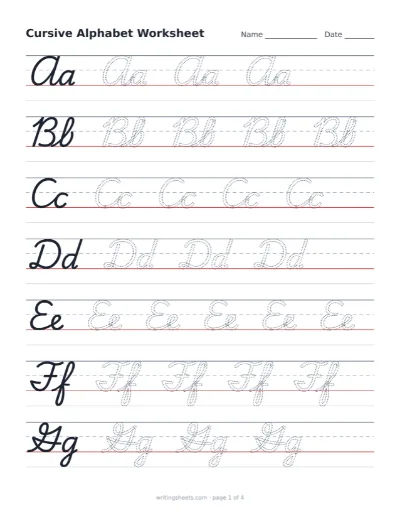
In the style on these sheets, the capitals B, D, F, O, P, T, V, W end without a joining stroke, so leave a small gap before the next letter. The others (A, C, E, G, H, I, J, K, L, M, N, Q, R, S, U, X, Y, Z) join on.
Capitals, Numbers and Your Own Words
See all the cursive capital letters grouped by their first stroke, cursive numbers and number words, or type anything into the cursive generator to see it in cursive.
Which Cursive Is This?
The letters here are traditional US school cursive, set in Playwrite US Trad, a free font made for teaching handwriting. US schools use a few close variants, and capitals such as G, Q and Z differ most between them. For British joined handwriting, choose "Joined" in the maker.