How Cursive Numbers Differ From Print
| Number | In cursive handwriting |
|---|---|
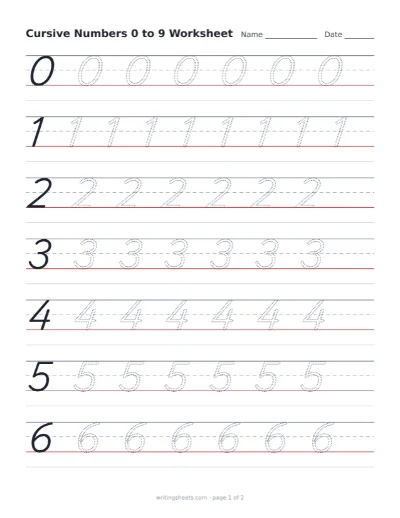
| All of them | Slanted forward at the same angle as the letters, so a row of numbers sits well in a line of cursive. Never joined to each other. |
| 1 | Often has a small flag at the top, a short stroke up to the start before the slant down, so it can't be read as an l. |
| 4 | Written closed, with a pointed top, in one stroke down, across and then a separate slant down through it. |
| 7 | A flat top and a long slant down. Many people add a short bar across the middle so the 7 can't be read as a 1, though US schools don't usually teach it. |
| 9 | A small oval at the top, then a stroke down that curves slightly at the bottom. |
| 0 | A narrow, slanted oval, narrower than the letter o. |
For how each digit is formed stroke by stroke, see number tracing, which uses upright print numbers for younger children.
Number Words in Cursive
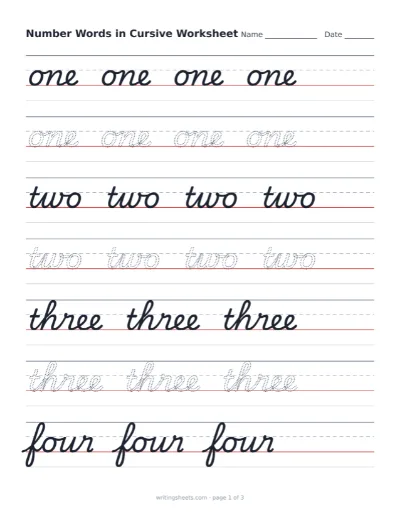
One to ten use 14 different letters, so writing them is good practice for the joins. Watch the joins after o in "one", w in "two" and v in "five" and "seven", which start from the midline, and the x in "six", crossed after the word is finished.
See also the cursive alphabet and cursive capital letters.