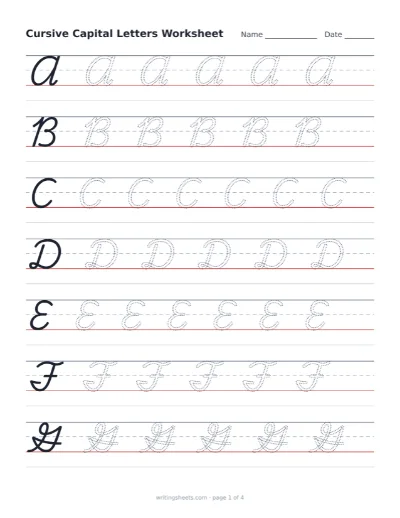
Cursive Capitals by First Stroke
Teachers bring in capitals a group at a time, because one first stroke learned unlocks the whole group.
Downcurve capitals
These start at the top line and curve down to the left, like a big c.
- Capital A: start at the top line and curve down and around to the left, all the way to the baseline.
- Capital C: start just below the top line with a small curve up and to the left.
- Capital E: start just below the top line with a small curve up and left.
- Capital O: start at the top line and curve to the left, down and around to the baseline.
Forward-curve capitals
These start at the top line with a small curve forward, then slant down.
- Capital H: start at the top line with a small curve and slant down to the baseline.
- Capital K: start at the top line with a small curve and slant down to the baseline, as for H.
- Capital M: start at the top line with a small curve and slant down to the baseline.
- Capital N: start at the top line with a small curve and slant down to the baseline.
- Capital U: start at the top line with a small curve and slant down toward the baseline.
- Capital V: start at the top line with a small curve forward.
- Capital W: start at the top line with a small curve forward and slant down to the baseline.
- Capital Y: start at the top line with a small curve forward and slant down to the baseline.
Overcurve capitals
These start with an overcurve sweeping up to the top line.
- Capital I: start just above the baseline with an overcurve that sweeps up and to the right, past the midline, to the top line.
- Capital J: start just above the baseline with an overcurve up to the top line, as for the capital I.
- Capital Q: start near the baseline with an overcurve, sweeping up to the top line.
- Capital X: start at the top line with an overcurve.
- Capital Z: start just below the top line with an overcurve up and to the right.
Stem capitals
These start at the top line with a straight slant down to the baseline.
- Capital B: start at the top line and slant straight down to the baseline.
- Capital D: start at the top line and slant down to the baseline.
- Capital P: start at the top line and slant down to the baseline.
- Capital R: start at the top line and slant down to the baseline.
Wave capitals
These start with a wavy stroke along the top line, then the stem.
- Capital F: make the wavy top stroke first, from left to right along the top line.
- Capital T: make the wavy top stroke first, from left to right along the top line.
Loop capitals
These start with a loop, from the baseline or just below the top line.
- Capital G: start on the baseline with an undercurve that goes up to the top line.
- Capital L: start just below the top line with a small loop going up and over to the left.
- Capital S: start on the baseline with an undercurve up to the top line.
Capitals That Don't Join the Next Letter
In traditional US cursive, B, D, F, O, P, T, V, W end without a joining stroke. Leave a small space after them and start the next letter fresh. The other capitals join on like small letters.
Capitals Written Like Their Small Letter
A few cursive capitals are simply bigger copies of the small letter: A, C, O, U, V, W, Y and Z. They are the easiest to start with.
For the small letters too, see the whole cursive alphabet, and for the digits, cursive numbers. To see a name with its capital in cursive, try the cursive name generator.