Where D'Nealian Comes From
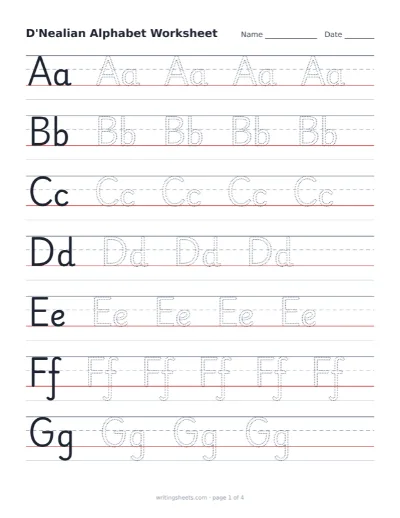
Donald Neal Thurber, a teacher in Michigan, developed D'Nealian in the 1960s and 1970s, and it was first published in 1978. His aim was to end the jump many children found hard: learning upright ball-and-stick print, then a quite different set of cursive letters a couple of years later.
D'Nealian Print
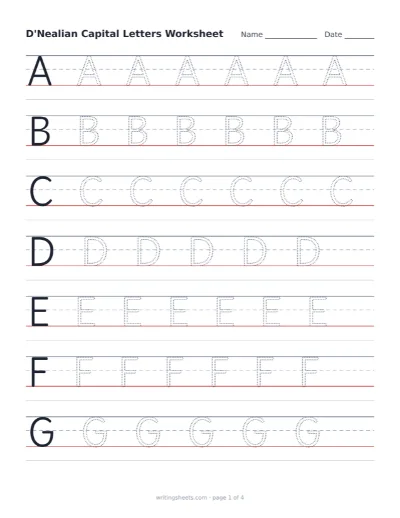
- Slanted, at about the same angle as cursive.
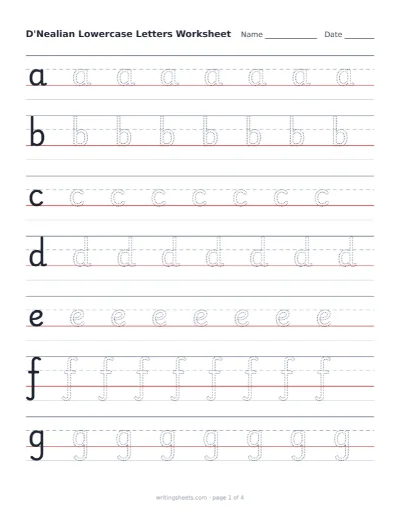
- Tails: most small letters end with a little upward hook, sometimes called a monkey tail. In cursive, that tail becomes the join.
- One stroke: most small letters are written without lifting the pencil.
- Ovals, not circles: the round letters are slanted ovals.
D'Nealian Cursive
Because the print already has the slant and the tails, most cursive letters are the print letters joined up. A few change shape, such as f, r, s and z, and the capitals have their own cursive forms. It's usually taught from second grade.
D'Nealian or Zaner-Bloser?
Zaner-Bloser print is upright and simple to read and copy; D'Nealian print takes a little longer to learn but leads more smoothly into cursive. Both are widely used, so follow your child's school. Compare all the styles on handwriting styles.
Sheets in This Style
Choose "Slanted Print" in the maker for slanted print in the D'Nealian family. The font is close to, not a copy of, the publisher's own letters.